Here is the video I was talking about:
Wednesday, April 30, 2008

Tuesday, April 29, 2008
Sirens- A different kind of montser.
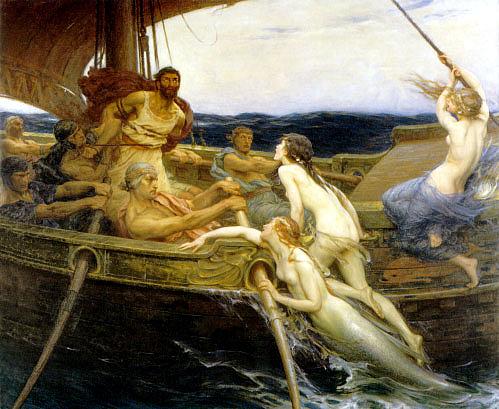
Sirens are sea demons, half woman and half bird. They are remarkable singers. According to the oldest legend Sirens lived on an island in the Mediterranean and attracted sailors passing nearby with their music. The ships would thus approach rocky coast and got ruined. The Sirens then devoured the imprudent sailors.
Sirens, like harpies, partake of women and of birds, in various ways. In early Greek art sirens were represented as birds with large women's heads, bird feathers and scaly feet and sometimes manes of lions. Later, they were represented as female figures with the legs of birds, with or without wings playing a variety of musical instruments, especially harps. The tenth century Byzantine encyclopedia Suda says that from their chests up Sirens had the form of sparrows, below they were women, or, alternatively, that they were little birds with women's faces. Birds were chosen because of their characteristic, beautiful voices. Later Sirens were sometimes also depicted as beautiful women, whose bodies, not only their voices, are seductive. The fact that in Spanish, French, Italian, Polish, Romanian or Portuguese, the word for mermaid are respectively Sirena, Sirène, Sirena, Syrena, Sirenă and Sereia creates visual confusion, so that sirens are even represented as mermaids. "The sirens, though they sing to mariners, are not sea-maidens," Harrison cautions; "they dwell on an island in a flowery meadow."
n Argonautica (4.891-919) Jason had been warned by Chiron that Orpheus would be necessary in his journey. When Orpheus heard their voices, he drew out his lyre and played his music more beautifully than they, drowning out their voices. One of the crew, however, the sharp-eared hero Butes, heard the song and leapt into the sea, but he was caught up and carried safely away by the goddess Aphrodite.
Odysseus was curious as to what the Sirens sounded like, so, on Circe's advice, he had all his sailors plug their ears with beeswax and tie him to the mast. He ordered his men to leave him tied to the mast, no matter how much he would beg. When he heard their beautiful song, he ordered the sailors to untie him but they stuck to their orders (or they couldn't hear him). When they had passed out of earshot, Odysseus demonstrated with his frowns to be released (Odyssey XII, 39).
Some post-Homeric authors state that the Sirens were fated to die if someone heard their singing and escaped them, and that after Odysseus passed by they therefore flung themselves into the water and perished. A varying tradition associates this event with their encounter with Jason, though the incident does not appear in Apollonius Rhodius's Argonautica. Many scholars believe the above vase depicts a drowning attempt on the part of one of the Sirens.
It is also said that Hera, queen of the gods, persuaded the Sirens to enter a singing contest with the Muses. The Muses won the competition and then plucked out all of the Sirens' feathers and made crowns out of themI chose to research sirens because I found it interesting that they are in fact monsters, but contradict the stereotype appearance wise, which I thought was cool.
Monday, April 28, 2008
What exactly is the Boogeyman?

The bogeyman, boogyman, bogyman, boogey monster, or boogeyman, is a folklore or legendary ghostlike monster often believed in by children. The bogeyman has no specific appearance whatsoever, and can in fact vary drastically from household to household within the same community; in many cases he simply has no set appearance in the mind of a child, but is simply an amorphous embodiment of terror. Bogeyman can be used metaphorically to denote a person or thing of which someone has an irrational fear. Parents often say that if their child is naughty, the bogeyman will get them, in an effort to make them behave. The bogeyman legend may originate from Scotland, where such creatures are sometimes called bogles, boggarts, or bogies.
Perhaps its ambiguity is what makes it so frightening. An example of the fear of the unknown. I think everyone has their own personal boogeyman, or fear of the unknown.
Perhaps it is a way of personifying death, an extremely grey or unknown subject for mortals to think about... so why not just call it the Boogeyman!?
Friday, April 25, 2008


the belly of the whale

In Joseph Campbell's "Hero With A Thousand Faces" he talks about the hero, any hero, sitting on the beach, or on a boat, waiting to fling himself into the mouth of the whale, or sea monster, whenever the opportunity presents itself.
Once in side the belly of the whale you are presented with absolute knowing and clarity. In the belly of the whale you can see all things, mountains, rivers, valleys, your future, your past.
Diving into the monster grants you access to beauty within yourself.
Maybe this is why we look for trouble as human beings. Hoping to find some clarity in these frightening situations.
Wednesday, April 23, 2008

"Medusa was a Gorgon, one of three sisters and daughters of ancient, pre-titan gods, Phorcys and Ceto.
The sisters Sthenno and Euryale were immortal but the third, Medusa, was mortal. All three were so hideous (“not to be approched and not to be described” according to Hesiod) that the mere shock of seeing them would turn anyone to stone. Medusa is called The Gorgon or simply, Gorgon. She is also the “Mistress of the West Gate of Death” because her home lay at the entrance to the Underworld on the side of the western Ocean. She is the Krone Goddess in her most terrible aspect."
This brings us to an interesting case where the subject was a goddess AND a monster. This also states that she was a mortal, which brings into question why she gained the role of a god-like character. She symbolized the female genitalia, and also the female sexuality, sort of like a really really mean Aphrodite.
This makes me think of the whole idea of TRANSFORMATION, which William hit upon in his werewolf post. I think the idea of transformation could be a very interesting idea to physicalize. What if you were faced in a position to actually transform? Even if you were adopting an evil role. How could you resist the transformation? Why are we not transformed into monsters in modern times when we do wicked things? Or are we simply emotionally and spiritually transformed.
As far as her becoming a goddess, how does a mortal deal with the information that they are inherently given some greater task than the simply human routine. What do you think about when this information is given to you?
I think it would be alot of responsibility.
Tuesday, April 22, 2008
Werewolves - Developed from Human Instinct?

Werewolves are thought to be created in many different ways. In modern fiction often the werewolf is transformed by the bite of another werewolf. Other werewolves are transformed by incantations, curses, and even in some cases a pact with the devil.
When we look at the werewolf we see a beast breaking free of the inner human psyche. Is this the animal instinct of humans breaking free? Maybe the werewolf is created from a tremendous emotional or physical experience. When a werewolf transforms we often see the moon is somehow involved, where did this come about?
In Native American mythology the idea of a werewolf is looked at from a dream state. The dream that you are a wolf or running with wolves. You are being called by the wolf spirit, or on a dream quest to see the wolf spirit. A dream is often at night, the moon shines at night, is this where the idea that werewolves are triggered by the moon comes from?
The most interesting part of the werewolf is the metamorphosis. The transformation from human to animal. Often the victim undergoes a series of horrible spasms and growths. When I think about how the transformation begins, I see a person lying down. They were just in a torrent of wind that left them dazed and confused. This tremendous physical extreme has left them in a weakened state. In this weakened state they can no longer control themselves. They resort to their animalistic instincts and suddenly tear themselves apart from the inside out. The transformation is complete, but what stands before us, human or beast?
Subscribe to:
Posts (Atom)